

“Development finance is not charity — it is the architecture of opportunity. DFIs are the engineers.”
— Senior Advisor, International Finance Corporation (IFC), Global Development Forum
Introduction: The Capital Bridge the World Needs
In a world where an estimated $4.2 trillion annually is needed to meet the United Nations Sustainable Development Goals (SDGs) by 2030 — yet private markets consistently fall short in frontier economies and underserved sectors — one category of institution has quietly become indispensable: the Development Finance Institution (DFI).
DFIs occupy a unique space in the international financial architecture. They are neither purely commercial banks nor unconditional aid agencies. Instead, they act as strategic intermediaries, channeling public and private capital toward projects that carry outsized social, economic, and environmental returns — but which commercial lenders alone would not finance.
From the skyscrapers of Washington D.C. where the World Bank Group operates, to the corridors of Abidjan where the African Development Bank (AfDB) structures transformative infrastructure deals, DFIs are reshaping the boundaries of global finance. Their influence extends into climate resilience, financial inclusion, digital infrastructure, healthcare, and gender-lens investing.
This blog post examines the rise of DFIs within the broader landscape of international finance, explores their structural mechanics, highlights global best practices, and offers forward-looking insights for financial professionals navigating an era of accelerating complexity.
What Is a Development Finance Institution (DFI)?
Defining the Term
A Development Finance Institution is a specialized financial intermediary — typically government-backed or multilaterally owned — established to provide long-term capital to development-oriented projects in emerging markets, developing economies, and underserved sectors where commercial financing is insufficient, unavailable, or prohibitively expensive.
Key characteristics that define DFIs include:
- Mandate-driven lending: Unlike commercial banks, DFIs have an explicit developmental mandate — poverty reduction, infrastructure development, climate finance, gender equity, or financial inclusion.
- Concessional and blended finance: DFIs often offer below-market interest rates, extended repayment tenors, and flexible security structures to de-risk investment.
- Additionality: DFI involvement is justified only where it provides additionality — mobilizing capital or enabling projects that would not otherwise proceed on commercial terms alone.
- ESG integration: Modern DFIs embed Environmental, Social, and Governance (ESG) principles throughout their investment lifecycle, from appraisal to impact monitoring.
Key Terms Defined
| Term | Definition |
| Financial Intermediation | The process by which financial institutions channel funds from savers/investors to borrowers/projects, reducing information asymmetry and transaction costs. |
| Maturity Transformation | The practice of funding long-term assets (e.g., 20-year infrastructure projects) using shorter-term liabilities — a core DFI function in illiquid markets. |
| Fiduciary Responsibility | The legal and ethical obligation of a financial institution to act in the best interest of its stakeholders — for DFIs, this includes both financial principals and the communities served. |
| Blended Finance | Strategic use of development funds to catalyze additional private sector investment in sustainable development goals. |
| Concessional Financing | Lending on terms more generous than market rates — including subsidized interest, extended grace periods, or non-commercial collateral requirements. |
| Additionality | The principle that DFI support should only be extended where it creates outcomes beyond what the market would otherwise deliver. |
The DFI Value Chain — From Capital Mobilization to Development Impact
The Global Architecture of Development Finance
Multilateral Development Banks (MDBs): The Apex Tier
At the apex of the DFI ecosystem sit the Multilateral Development Banks (MDBs) — institutions owned by multiple member governments that pool sovereign capital to finance development at scale.
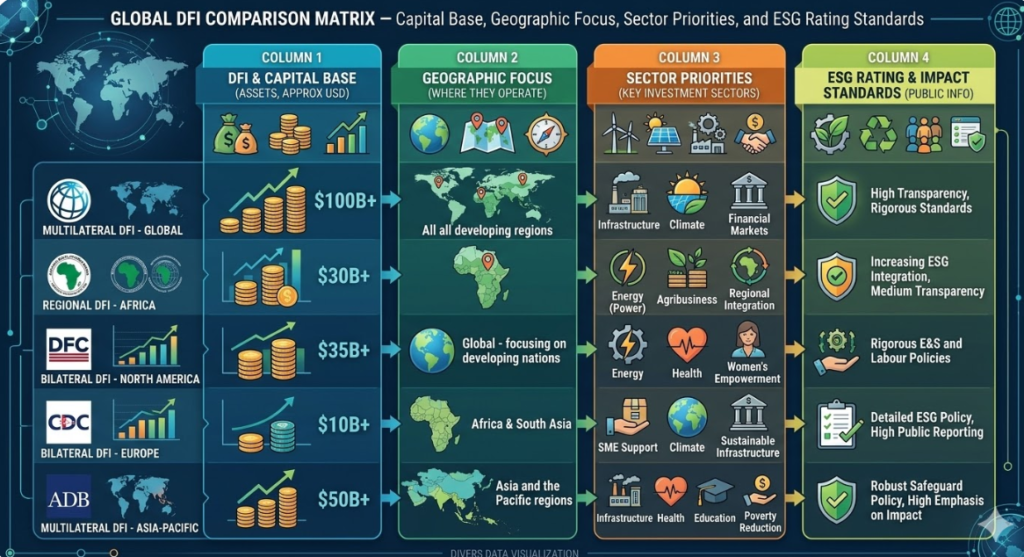
The World Bank Group is the most prominent example. With over $100 billion in annual commitments across its five affiliated institutions — including the International Bank for Reconstruction and Development (IBRD), the International Development Association (IDA), and the International Finance Corporation (IFC) — the World Bank Group sets the global standard for development finance practice.
The IFC in particular represents a critical evolution: a DFI that works exclusively with the private sector, offering equity investments, loans, risk management tools, and advisory services to unlock commercial investment in developing markets. IFC’s Managed Co-Lending Portfolio Program (MCPP) has mobilized billions in institutional investor capital — including from pension funds and sovereign wealth funds — into emerging market infrastructure.
Regional MDBs operate parallel mandates calibrated to their geographies:
- African Development Bank (AfDB): Headquartered in Abidjan, the AfDB finances energy, agriculture, industrialization, regional integration, and improving living conditions across 54 African member countries. Its Desert to Power Initiative targets 10,000 MW of solar energy across the Sahel.
- Asian Development Bank (ADB): Manila-based, with a portfolio targeting poverty reduction and sustainable development across Asia-Pacific, increasingly focused on climate resilience and digital infrastructure.
- Inter-American Development Bank (IDB): Serving Latin America and the Caribbean with a particular focus on inequality reduction, digital economy, and climate adaptation.
- European Bank for Reconstruction and Development (EBRD): Operates across 38 countries from Morocco to Mongolia, with a distinctive mandate for private sector development and democratic governance.
- Islamic Development Bank (IsDB): Applies Shariah-compliant financing principles to development projects across 57 member countries.
Bilateral DFIs: National Mandates, Global Reach
Beyond MDBs, bilateral DFIs — institutions established by individual governments — play an increasingly significant role in channeling sovereign development capital internationally.
Notable examples (without naming domestic commercial banks) include:
- U.S. International Development Finance Corporation (DFC): America’s development bank, deploying up to $60 billion in financing for projects advancing U.S. foreign policy and development objectives.
- British International Investment (BII): The UK government’s DFI, formerly known as CDC Group, with a focus on sustainable, inclusive economic growth in Africa and Asia.
- DEG (Deutsche Investitions- und Entwicklungsgesellschaft): Germany’s development finance institution, a subsidiary of KfW Group, financing private enterprise in developing and emerging markets.
- Proparco: France’s DFI, affiliated with Agence Française de Développement (AFD), focusing on the private sector in emerging economies.
“Global DFI Comparison Matrix — Capital Base, Geographic Focus, Sector Priorities, and ESG Rating Standards”
How DFIs Work: The Mechanics of Development Finance
The Blended Finance Model
The most transformative innovation in development finance over the past two decades is blended finance — the strategic use of concessional public funds to mobilize commercial private capital toward high-impact projects.
How blended finance structures work:
- First-loss tranches: DFIs or donor funds absorb the first losses on a portfolio or project, reducing perceived risk for commercial co-investors.
- Guarantees and risk-sharing facilities: DFIs provide partial credit guarantees, political risk insurance, or currency hedging to make frontier market investments bankable.
- Technical assistance grants: DFIs fund project preparation, feasibility studies, and capacity building — reducing the due diligence burden for private investors.
- Equity anchoring: DFI equity participation signals credibility and provides governance oversight, encouraging institutional investors to follow.
Case Study — IFC and M-Pesa: The expansion of mobile money across Sub-Saharan Africa — exemplified by M-Pesa, originally launched in Kenya by Safaricom — was materially supported by IFC advisory and investment in the enabling ecosystem. IFC recognized that financial intermediation at the last mile required not just capital, but technological infrastructure and regulatory collaboration. Today, M-Pesa processes over $300 billion in transactions annually and serves as a global model for digital financial inclusion — cited in World Bank financial inclusion reports and IMF working papers on the digitization of payments.
Risk Management in DFI Portfolios
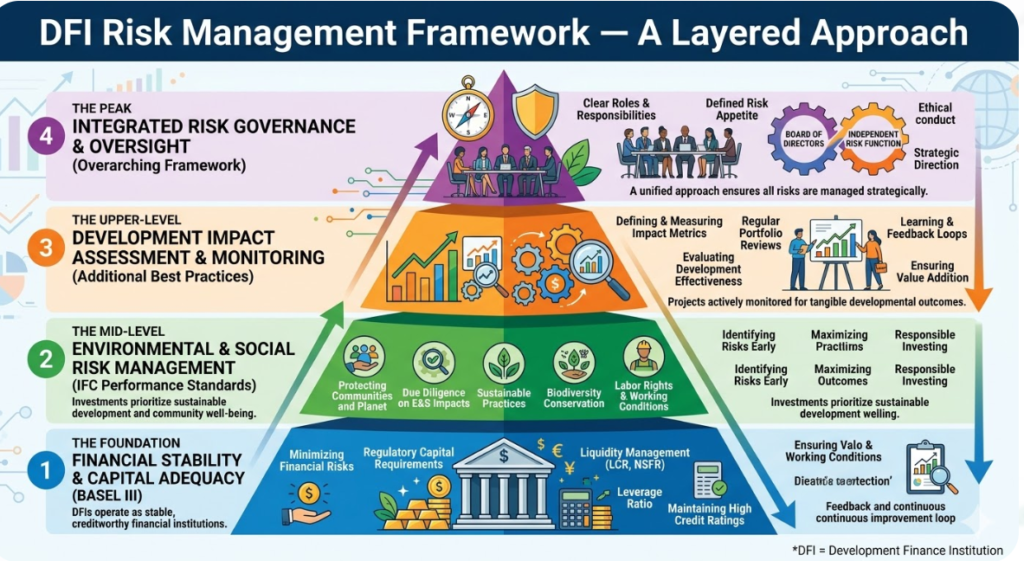
DFIs operate in risk environments that far exceed those encountered by conventional commercial banks. Their toolkit for risk management draws from global frameworks while incorporating development-specific adaptations:
- Country and Political Risk: Evaluated using IMF Article IV consultation data, political risk indices, and proprietary DFI country risk models. Instruments include political risk insurance (offered by the Multilateral Investment Guarantee Agency/MIGA, a World Bank Group member).
- Currency and Liquidity Risk: In frontier markets where maturity transformation is most needed, currency mismatch between USD/EUR-denominated funding and local-currency revenues is a persistent challenge. DFIs increasingly partner with the TCX Fund (The Currency Exchange Fund) to hedge local currency exposure.
- Credit Risk: DFIs apply robust credit appraisal frameworks aligned with — and often exceeding — the standards of the Basel Committee on Banking Supervision (Basel III/IV), including rigorous stress testing, counterparty risk assessment, and portfolio concentration limits.
- Environmental and Social Risk: Governed by internationally recognized standards such as the IFC Performance Standards — widely adopted as the global benchmark for environmental and social risk management in project finance — and the Equator Principles, adhered to by over 130 financial institutions worldwide.
DFI Risk Management Framework — A Layered Approach from Basel III to IFC Performance Standards
ESG Integration: From Compliance to Competitive Advantage
The Evolution of ESG in Development Finance
Environmental, Social, and Governance principles are not new to DFIs — they have always operated with a mandate that encompasses social outcomes. What has changed is the sophistication, granularity, and verification rigor of ESG frameworks applied.
Today’s leading DFIs align their ESG practices with:
- UN Sustainable Development Goals (SDGs): Reporting against SDG contribution across investment portfolios.
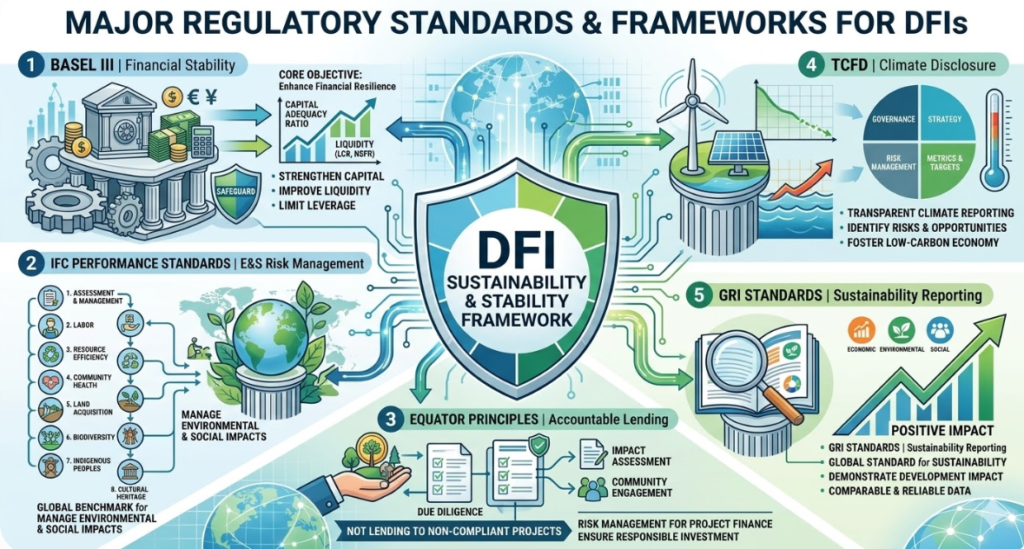
- Paris Agreement on Climate Change: Net-zero transition commitments, climate finance targets, and climate risk integration per TCFD (Task Force on Climate-related Financial Disclosures) recommendations.
- IFC Performance Standards: Eight standards covering environmental assessment, labor, community health, land acquisition, biodiversity, cultural heritage, indigenous peoples, and grievance mechanisms.
- Global Reporting Initiative (GRI): Standardized ESG disclosure.
- SASB Standards: Sector-specific sustainability accounting guidance.
Climate Finance: DFIs at the Forefront
DFIs have emerged as the primary mobilizers of climate finance globally. According to the Climate Policy Initiative, global climate finance flows exceeded $1.3 trillion in 2022, with MDBs and DFIs accounting for a disproportionate share of mobilization in emerging markets.
Key innovations in DFI climate finance include:
- Green Bond Issuance: The World Bank issued the world’s first labeled green bond in 2008. Today, the green bond market exceeds $500 billion annually, with DFIs serving as both issuers and standard-setters.
- Climate Risk Stress Testing: DFIs increasingly integrate physical and transition climate risks into credit assessments, aligned with Network for Greening the Financial System (NGFS) scenarios.
- Nature-Based Solutions Financing: The IDB and AfDB have pioneered debt-for-nature swaps and blue/green bond structures for ecosystem preservation.
“The next frontier for DFIs is not just financing the energy transition, but financing the just transition — ensuring that communities most affected by climate change are not left behind by climate finance itself.”
— Climate Finance Director, Multilateral Development Bank Network
Digital Transformation and FinTech Innovation in DFIs
The Digital Imperative
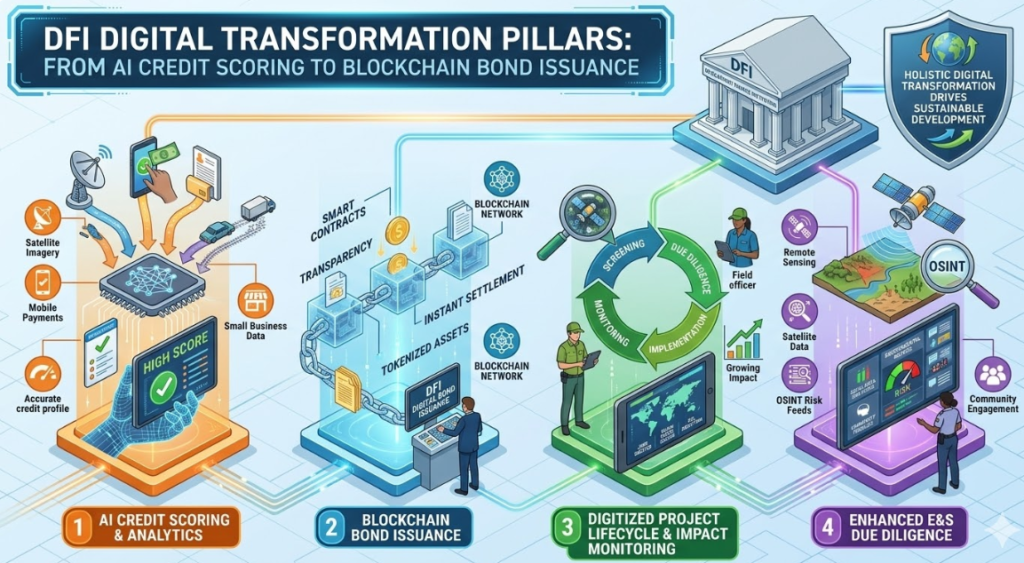
Development finance institutions are undergoing a profound digital transformation, recognizing that technology is both an enabling tool and a development outcome. Key dimensions include:
1. Digital Infrastructure Finance DFIs are increasingly directing capital toward broadband connectivity, cloud infrastructure, digital payment rails, and e-government platforms — recognizing that digital infrastructure is foundational to economic participation. The ADB’s Digital Finance Initiatives and IFC’s investments in fintech platforms across Africa and Southeast Asia exemplify this shift.
2. AI and Data Analytics in Credit Assessment Leading DFIs are deploying artificial intelligence and machine learning to improve the accuracy and efficiency of:
- Credit scoring for SMEs and micro-enterprises lacking traditional collateral
- Portfolio risk monitoring and early warning systems
- Environmental and social compliance monitoring via satellite imagery and sensor data
3. Blockchain and Distributed Ledger Applications The World Bank’s Blockchain Lab and pilot programs at the IDB and ADB have explored blockchain applications in:
- Cross-border payment efficiency
- Land registry and property rights recording
- Supply chain finance for smallholder farmers
- Bond issuance and settlement (World Bank’s bond-i blockchain bond)
4. Digital Financial Inclusion DFIs are investing in digital financial infrastructure that reaches unbanked and underbanked populations — supporting mobile money operators, agent banking networks, and regulatory sandboxes for fintech innovation. This aligns with the GSMA’s Mobile Money State of the Industry Report findings that mobile money accounts now exceed 1.6 billion globally.
“DFI Digital Transformation Pillars — From AI Credit Scoring to Blockchain Bond Issuance”
Regulatory Governance and International Standards
Operating Within the Global Regulatory Framework
DFIs operate within — and often help shape — the global regulatory architecture for financial institutions. Understanding their regulatory positioning is essential for finance professionals.
Basel Committee on Banking Supervision While DFIs are often exempt from national banking supervision (due to their supranational or quasi-governmental status), leading institutions voluntarily align with Basel III capital adequacy and liquidity standards as a matter of financial prudence and creditor confidence. The World Bank Group, for example, maintains capital adequacy ratios and liquidity buffers consistent with or exceeding Basel norms.
IMF Surveillance and Article IV Consultations DFIs rely heavily on IMF macroeconomic assessments — including Article IV consultations and Debt Sustainability Analyses (DSAs) — to calibrate country risk, guide concessional lending decisions, and coordinate with other creditors on debt restructuring.
OECD DAC Principles The OECD Development Assistance Committee (DAC) sets norms on what constitutes Official Development Assistance (ODA), directly influencing how bilateral DFIs report concessional lending and whether their activities are counted toward donor countries’ 0.7% GNI ODA targets.
Securities Regulation for Bond Issuance When DFIs tap international capital markets — as MDBs routinely do to fund lending at scale — they operate within the frameworks of the SEC (U.S. Securities and Exchange Commission) and FCA (UK Financial Conduct Authority), among other regulators, requiring rigorous disclosure, prospectus compliance, and investor protection standards.
The G20 MDB Capital Adequacy Framework Review In 2022, the G20 commissioned an Independent Review of MDB Capital Adequacy Frameworks, finding that MDBs had significant untapped borrowing capacity. This has catalyzed a new wave of capital optimization innovations — including callable capital mobilization, hybrid capital instruments, and risk transfer to private investors — that will expand DFI firepower without requiring new shareholder capital injections.
Regulatory Standards Applicable to DFIs — Basel III, IFC Performance Standards, Equator Principles, TCFD, GRI
Best Practices in DFI Governance and Operational Excellence
Governance Standards
Effective DFI governance is built on principles that reflect the highest standards of international public finance:
- Independent Board Oversight: DFI boards typically include representatives from member governments, independent directors, and increasingly, civil society representatives — ensuring accountability to both shareholders and beneficiaries.
- Transparency and Disclosure: Leading DFIs publish comprehensive annual reports, project disclosure databases, and environmental and social impact assessments consistent with Access to Information policies modeled on World Bank standards.
- Anti-Corruption and Integrity Frameworks: DFIs apply rigorous anti-bribery, anti-money laundering (AML), and Know Your Customer (KYC) protocols in line with the FATF Recommendations and institutional integrity frameworks.
- Grievance Mechanisms: Independent accountability mechanisms — such as the World Bank’s Inspection Panel and IFC’s Compliance Advisor Ombudsman (CAO) — allow project-affected communities to raise concerns about DFI-financed operations.
Measuring Development Impact
A defining challenge — and evolving best practice — for DFIs is measuring, reporting, and attributing development impact. Leading frameworks include:
- IRIS+ (by GIIN): The Global Impact Investing Network’s standardized impact metrics taxonomy, adopted by numerous DFIs for portfolio-level impact tracking.
- Operating Principles for Impact Management: Nine principles endorsed by 130+ institutions globally for designing and managing impact-oriented investment portfolios.
- Joint Impact Model (JIM): A collaborative tool developed by 14 European DFIs to estimate economic, social, and environmental outcomes from private sector investments.
“Impact measurement is no longer a ‘nice to have’ for DFIs — it is the currency of accountability. Institutions that cannot demonstrate additionality and impact will struggle for relevance and capital in the decade ahead.”
— Managing Director, European Development Finance Institutions (EDFI) Network
Case Studies: DFIs in Action
Case Study 1: The African Development Bank and Desert to Power
The AfDB’s Desert to Power Initiative demonstrates DFI catalytic finance at its most ambitious. The program aims to develop 10,000 MW of solar energy across the G5 Sahel countries — Burkina Faso, Chad, Mali, Mauritania, and Niger — to provide electricity to 250 million people by 2030.
The financing structure combines:
- AfDB sovereign and non-sovereign loans
- Concessional IDA/ADF resources
- EU blended finance guarantees
- Private sector co-investment mobilized through risk-sharing facilities
This exemplifies maturity transformation — long-tenor infrastructure financing (20–25 years) mobilized through blended public-private structures in markets where commercial banks offer at most 5–7 year tenors.
Case Study 2: IFC and the Emerging Markets Private Equity Ecosystem
The IFC has been instrumental in building the private equity and venture capital ecosystem across emerging markets. Through its IFC Asset Management Company (AMC), it manages third-party capital from sovereign wealth funds, pension funds, and institutional investors — deploying it in IFC-originated transactions.
This model — effectively turning the IFC into an asset manager for development — has mobilized over $10 billion in third-party institutional capital that would not otherwise have reached emerging market equities. It represents a sophisticated application of financial intermediation theory: reducing information asymmetry and transaction costs for global investors seeking emerging market exposure.
Case Study 3: EBRD and Digital Transition in Central Asia
The European Bank for Reconstruction and Development (EBRD) has pioneered a digital economy transition framework for Central Asia and the Western Balkans — financing broadband infrastructure, e-government platforms, digital payment systems, and fintech regulatory frameworks.
Notably, EBRD’s Digital Infrastructure Initiative incorporates cybersecurity standards aligned with EU frameworks, ensuring that digital investment in frontier markets meets international resilience requirements — a crucial dimension often overlooked in infrastructure finance.
Frequently Asked Questions (FAQ)
Q1: How do DFIs differ from commercial banks or multilateral aid agencies?
DFIs occupy a middle ground between commercial banks (which prioritize financial returns) and grant-making aid agencies (which prioritize development outcomes regardless of financial sustainability). DFIs must achieve both: financial self-sustainability through loan repayment and equity returns, while generating measurable development impact. This “double bottom line” mandate shapes every aspect of their operations — from credit assessment to portfolio monitoring to capital structure.
Q2: How do DFIs mobilize private capital, and what instruments do they use?
DFIs use a range of instruments to crowd in private capital:
- First-loss guarantees that absorb initial credit losses
- Political risk insurance via MIGA and bilateral guarantee agencies
- Syndicated loans where DFIs serve as mandated lead arranger and sell participations to commercial banks
- Blended finance structures combining concessional and market-rate tranches
- Co-investment platforms (like IFC’s MCPP) that allow institutional investors to co-invest alongside DFI portfolios
Q3: What is the role of ESG in DFI investment decisions?
ESG is central to — not peripheral to — DFI investment decisions. Environmental and social due diligence is a prerequisite for project approval, not an afterthought. Projects that cannot meet minimum standards under the IFC Performance Standards or Equator Principles are typically declined or restructured. Governance quality — including anti-corruption measures, board independence, and stakeholder accountability — is a key factor in determining DFI support and pricing. Increasingly, DFIs are also integrating climate risk assessments aligned with TCFD into standard credit appraisals.
Emerging Trends: The Future of Development Finance
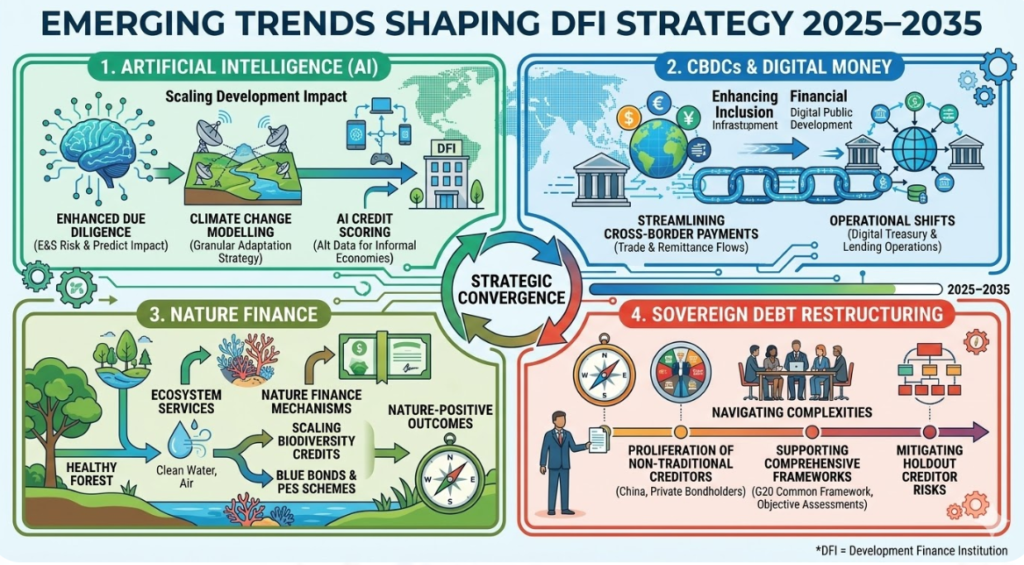
1. AI-Powered Development Finance
Artificial intelligence is reshaping DFI operations across three dimensions:
- Credit and risk analytics: AI models improve portfolio-level risk prediction, reducing non-performing loan ratios in complex emerging market environments.
- Impact measurement: Machine learning applied to satellite imagery, mobile data, and household surveys enables real-time tracking of development outcomes.
- Operational efficiency: Natural language processing automates due diligence documentation review, compliance checking, and reporting.
2. Digital Currencies and Cross-Border Payments
The emergence of Central Bank Digital Currencies (CBDCs) and stablecoin infrastructure presents both opportunities and challenges for DFIs:
- DFIs are engaging with IMF and BIS research on CBDC interoperability to assess implications for cross-border payment corridors in developing economies.
- Faster, cheaper cross-border payments could dramatically reduce remittance costs — a key financial inclusion priority for institutions like the World Bank.
- DFIs are also piloting digital bond issuance on distributed ledger platforms to reduce settlement risk and expand investor access.
3. Nature and Biodiversity Finance
Following the Kunming-Montreal Global Biodiversity Framework (COP15, 2022), DFIs are under growing pressure to:
- Align portfolios with nature-positive outcomes
- Finance biodiversity conservation and ecosystem services
- Apply nature-related financial risk assessment aligned with the TNFD (Taskforce on Nature-related Financial Disclosures) framework
4. Debt Sustainability and Sovereign Debt Restructuring
With sovereign debt distress at historic levels in many developing economies — as documented in IMF Debt Sustainability Analyses — DFIs face complex questions about:
- Balancing concessional lending with debt sustainability
- Participating in the G20 Common Framework for debt restructuring
- Developing innovative instruments (e.g., GDP-linked bonds, debt-for-climate swaps) that align repayment obligations with economic performance
Emerging Trends Shaping DFI Strategy 2025–2035 — AI, CBDCs, Nature Finance, and Sovereign Debt Restructuring
Conclusion: The Indispensable Intermediary
Development Finance Institutions have moved from the margins to the mainstream of global financial governance. In an era defined by interconnected crises — climate change, digital divides, sovereign debt stress, geopolitical fragmentation — DFIs have emerged as the indispensable intermediaries between the capital markets of the developed world and the development imperatives of the emerging world.
For financial professionals, the rise of DFIs offers important lessons:
- Blended finance is not a niche — it is a scalable architecture for directing private capital toward public good.
- ESG integration is not risk mitigation alone — it is value creation and resilience building in complex operating environments.
- Digital transformation is not optional — institutions that fail to harness AI, data analytics, and digital infrastructure will struggle to remain relevant in the next decade of development finance.
- Governance quality determines impact quality — the most sophisticated financial instrument is only as good as the institutional integrity behind it.
As the world approaches the 2030 SDG deadline and navigates an accelerating climate transition, DFIs will need to scale their ambitions, innovate their instruments, and deepen their private sector partnerships. The question is not whether DFIs matter — it is whether the world will summon the political will and institutional creativity to unlock their full potential.
External Resource Links
(Suggested for editorial team to hyperlink in CMS)
- World Bank Group Annual Report
- IFC Performance Standards
- Basel Committee on Banking Supervision
- IMF World Economic Outlook
- OECD DAC Development Finance Statistics
- Climate Policy Initiative — Global Landscape of Climate Finance
- TCFD Recommendations
- Equator Principles
- GIIN — IRIS+ Impact Metrics
- African Development Bank Group
© All rights reserved. This content is for informational and educational purposes only and does not constitute financial, legal, or investment advice.