
Introduction:
Who Stands Between Investors and Chaos?
In 2022, the collapse of a major crypto exchange erased billions of dollars in investor wealth within days — a stark reminder that unregulated markets are not free markets; they are dangerous markets. Every functional capital market in the world owes its credibility to a silent but powerful infrastructure: securities regulation.
“Markets are not self-regulating. History has proven, time and again, that without oversight, confidence collapses and capital flees.” — Former Senior Adviser, International Monetary Fund (IMF)
Across the globe, securities regulators serve as the custodians of market integrity. Whether it is the Securities and Exchange Commission (SEC) in the United States, the Financial Conduct Authority (FCA) in the United Kingdom, the European Securities and Markets Authority (ESMA) in the European Union, or dozens of their counterparts on every continent, these institutions perform one fundamental mission: to ensure that financial markets operate with fairness, transparency, and accountability.
This article examines the architecture of global securities regulation — how it works, who enforces it, why it matters, and where it is heading in an era of artificial intelligence, digital assets, and sustainable finance.
Part I: Foundations — What Securities Regulators Actually Do
Defining Key Terms
To understand how securities regulators function, it is essential to first grasp the concepts they govern:
- Securities: Financial instruments — stocks, bonds, derivatives, ETFs, and increasingly digital tokens — that represent ownership, debt, or a right to future cash flows.
- Market Transparency: The principle that all material information relevant to investment decisions must be accessible, accurate, and timely for all market participants.
- Investor Protection: The legal and regulatory frameworks designed to shield individual and institutional investors from fraud, misrepresentation, and market manipulation.
- Fiduciary Responsibility: The legal obligation of financial advisors, asset managers, and corporate directors to act in the best interests of the clients or shareholders they serve.
- Market Surveillance: The use of technology and data analytics by regulators to monitor trading activity and detect anomalies, insider trading, or systemic risks in real time.
- Systemic Risk: The risk that the failure of one institution or market segment triggers a cascade of failures across the broader financial system — as witnessed during the 2008 Global Financial Crisis.
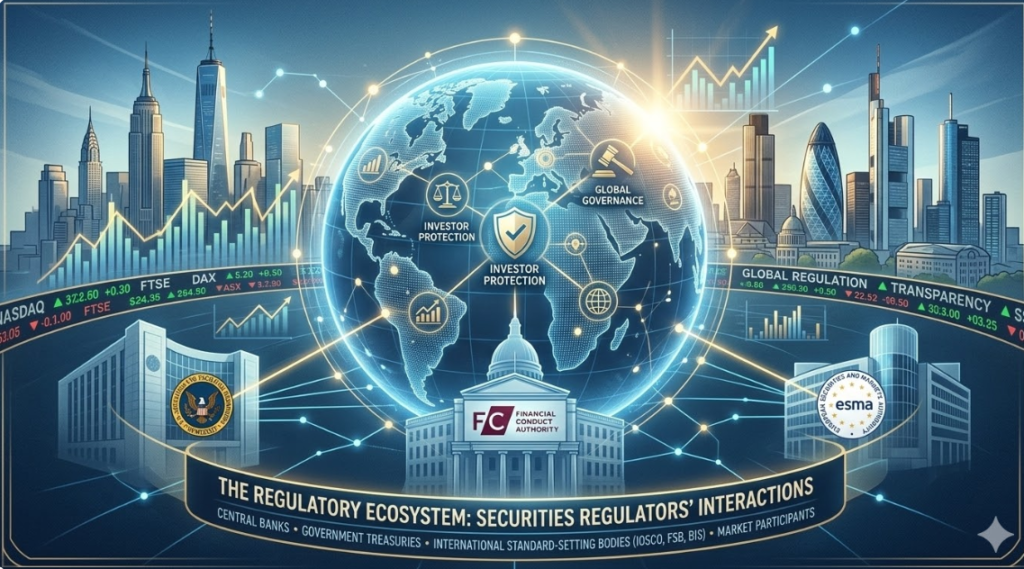
📊 The Regulatory Ecosystem” — a diagram showing how securities regulators interact with central banks, government treasuries, international standard-setting bodies (IOSCO, FSB, BIS), and market participants.
Why Securities Regulation Exists: A Brief History
Securities regulation did not emerge from theory — it emerged from catastrophe. The Wall Street Crash of 1929, which wiped out an estimated $30 billion in market value (equivalent to over $500 billion today), exposed the raw vulnerability of unregulated capital markets. Fraudulent prospectuses, insider manipulation, and opaque corporate reporting had fueled speculative bubbles that inevitably burst.
Governments worldwide responded by building institutional frameworks for oversight. The principle was universal: markets need rules to function, and rules need enforcers to matter.
Today, the International Organization of Securities Commissions (IOSCO) — the global standard-setter for securities regulation — brings together over 130 regulators from more than 100 jurisdictions, collectively overseeing approximately 95% of the world’s securities markets.
Part II: The Major Guardians — A Global Survey
🇺🇸 The SEC: The Benchmark for Global Regulation
The U.S. Securities and Exchange Commission, established in 1934 in the aftermath of the Great Depression, is arguably the most influential securities regulator in the world. It oversees:
- Equity and debt markets on U.S. exchanges (NYSE, NASDAQ, and others)
- Investment advisers and funds managing trillions in assets
- Corporate disclosures through mandatory filings (10-K, 10-Q, 8-K)
- Enforcement against securities fraud, insider trading, and market manipulation
The SEC’s enforcement record is formidable. Between 2019 and 2023, it returned more than $20 billion to harmed investors through disgorgement and penalties. Its landmark actions — from prosecuting Enron executives to challenging unregistered crypto securities — have shaped global enforcement norms.
Key Regulatory Frameworks:
- The Securities Act of 1933 (disclosure of new securities)
- The Securities Exchange Act of 1934 (ongoing market regulation)
- Dodd-Frank Wall Street Reform and Consumer Protection Act (2010, post-GFC)
- The JOBS Act (2012, enabling innovation in capital formation)
🔗 External Link Suggestion: SEC’s official EDGAR database for corporate filings — www.sec.gov/edgar
🇬🇧 The FCA: Conduct, Culture, and Consumer Focus
The Financial Conduct Authority, established in 2013 following the dissolution of the Financial Services Authority (FSA), represents a deliberate pivot from institutional stability-focused oversight to conduct and consumer protection as core regulatory priorities.
The FCA oversees approximately 50,000 financial firms in the United Kingdom, with a mandate spanning:
- Market integrity: preventing insider dealing, market abuse, and manipulation
- Consumer protection: ensuring products are fair, transparent, and suitable
- Competition: fostering innovation without enabling monopolistic behavior
- ESG and sustainability disclosures: among the most progressive in the world
The FCA’s Consumer Duty regulation, effective 2023, mandates that all regulated firms deliver good outcomes for retail customers — a principle-based approach that is influencing regulatory thinking across Asia, Australia, and Africa.
Notable FCA Actions:
- Landmark enforcement against major global banks for LIBOR manipulation (resulting in billions in fines globally)
- Regulation of cryptoasset promotions to UK consumers
- Requirements for diversity and inclusion reporting within regulated firms
🇪🇺 ESMA: Harmonizing Europe’s Capital Markets
The European Securities and Markets Authority operates as a supranational body — a regulator of regulators — tasked with harmonizing securities laws across the EU’s 27 member states. Its mandate includes:
- Developing technical standards that national authorities must implement
- Direct supervisory authority over specific entities, including Credit Rating Agencies (CRAs) and trade repositories
- Convergence work: ensuring that a securities rule in Germany is effectively identical in practice to that in Spain or Poland
- Market risk monitoring: publishing the ESMA Risk Dashboard, a key tool for assessing systemic risks across European capital markets
ESMA’s landmark work on the Markets in Financial Instruments Directive (MiFID II) — which transformed transaction reporting, best execution, and research unbundling — set a new global benchmark for market microstructure regulation.
“Comparative Overview of SEC, FCA, and ESMA” — columns for jurisdiction, founding year, primary mandate, number of regulated entities, key legislation, and ESG framework.
🌏 Beyond the West: Regulators Reshaping Global Finance
Securities and Exchange Board of India (SEBI) SEBI has emerged as one of the most dynamic regulators in emerging markets, overseeing one of the world’s largest investor bases — with over 130 million registered investors as of 2024. SEBI has been a pioneer in integrating Business Responsibility and Sustainability Reporting (BRSR) into listed company obligations, well ahead of many developed-market peers.
China Securities Regulatory Commission (CSRC) Overseeing the world’s second-largest equity market by capitalization, the CSRC has accelerated market reforms — including the Shanghai-Hong Kong Stock Connect, Bond Connect programs, and liberalization of access for foreign institutional investors — while maintaining strict control over capital flows.
Monetary Authority of Singapore (MAS) MAS functions as both central bank and financial regulator, making it one of the most efficiently integrated oversight bodies globally. Its Project Guardian initiative — exploring tokenization of financial assets — places Singapore at the frontier of digital finance regulation.
Capital Markets Authority (CMA) — Kenya and across Africa Across sub-Saharan Africa, regulators like Kenya’s CMA are confronting the challenge of building market infrastructure for inclusion. Kenya’s mobile money ecosystem, epitomized by M-Pesa, has forced regulators to innovate frameworks that sit at the intersection of banking, payments, and securities — a regulatory frontier watched globally.
Part III: The Architecture of Investor Protection
Three Pillars of Market Integrity
Effective securities regulation globally rests on three interdependent pillars:
1. Disclosure and Transparency The foundation of investor protection is the mandatory disclosure of material information. Listed companies must regularly publish audited financial statements, material events, insider transactions, and risk factors. Regulators enforce these obligations through detailed filing requirements and penalties for non-disclosure or misrepresentation.
The shift toward IFRS (International Financial Reporting Standards) — adopted in over 140 countries — has significantly improved cross-border comparability of corporate disclosures, facilitating global capital allocation by institutions like BlackRock, the world’s largest asset manager, which deploys capital across markets requiring consistent disclosure quality.
2. Market Surveillance and Enforcement Modern regulators rely heavily on technology. The SEC’s MIDAS (Market Information Data Analytics System) processes billions of data points daily, enabling detection of unusual trading patterns consistent with insider trading or market manipulation. Similarly, ESMA’s transaction reporting system processes hundreds of millions of records monthly across EU jurisdictions.
Enforcement powers vary by jurisdiction but typically include:
- Civil penalties and disgorgement of illicit gains
- Trading suspensions and market bans
- Criminal referrals for serious fraud or manipulation
- Cross-border cooperation through IOSCO’s MMoU (Multilateral Memorandum of Understanding)
3. Market Structure and Systemic Risk Oversight Securities regulators increasingly coordinate with central banks and macro-prudential authorities on systemic risk. Post-2008, this coordination — formalized through institutions like the Financial Stability Board (FSB) and national bodies like the U.S. Financial Stability Oversight Council (FSOC) — ensures that securities markets do not become vectors of broader financial instability.
💬 “The 2008 crisis taught us that securities markets and banking systems are deeply interconnected. Regulation in silos creates gaps that crisis exploits.” — Senior Policy Adviser, Financial Stability Board
Part IV: ESG, FinTech, and the New Regulatory Frontier
ESG Disclosure: From Voluntary to Mandatory
The integration of Environmental, Social, and Governance (ESG) factors into securities regulation represents the most significant paradigm shift in financial oversight in decades. What began as voluntary corporate reporting has rapidly become a compliance obligation in major markets:
- EU Sustainable Finance Disclosure Regulation (SFDR): Requires all EU financial market participants to categorize products by sustainability characteristics (Articles 6, 8, and 9), with mandatory principal adverse impact disclosures.
- SEC Climate Disclosure Rule (2024): Mandates that U.S. public companies disclose material climate-related risks, Scope 1 and 2 emissions, and climate governance structures.
- ISSB Standards (IFRS S1 and S2): The International Sustainability Standards Board, operating under the IFRS Foundation, has established globally consistent baseline standards for sustainability-related financial disclosures — adopted or being adopted across Asia, Latin America, and Africa.
- FCA Sustainability Disclosure Requirements (SDR): Anti-greenwashing rules requiring UK investment products using sustainability labels to meet stringent criteria.
This shift reflects a recognition that climate risk is financial risk — a position now endorsed by the IMF, World Bank, Bank for International Settlements (BIS), and virtually all major central banks.
“Growth of ESG Disclosure Mandates Globally 2015–2025” — timeline showing adoption of SFDR, TCFD, ISSB, SEC climate rules across regions.
FinTech, Crypto, and the Regulatory Innovation Race
The rise of FinTech — and particularly decentralized finance (DeFi), digital assets, and tokenization — has forced securities regulators to run a regulatory innovation race. The core challenge: applying principles designed for centralized, identifiable financial intermediaries to decentralized, pseudonymous, and borderless systems.
Key Regulatory Responses:
- MiCA (Markets in Crypto Assets Regulation) — EU: The world’s most comprehensive crypto regulatory framework, effective 2024, establishing requirements for issuers of crypto assets and providers of crypto services, including stablecoins.
- SEC’s Enforcement-First Approach — US: The SEC has pursued aggressive enforcement actions against major crypto exchanges and token issuers, asserting that most tokens qualify as securities under the Howey Test.
- MAS’s Regulatory Sandbox — Singapore: A structured environment allowing FinTech firms to experiment with innovative financial services under relaxed regulatory requirements — a model replicated across the UK, Australia, and the UAE.
- Project Mariana — BIS: A cross-border experiment exploring automated market makers for wholesale central bank digital currency (CBDC) settlement, involving the BIS Innovation Hub alongside multiple central banks.
The tokenization of real-world assets (RWAs) — including government bonds, real estate, and private credit — is projected to become a multi-trillion-dollar market by 2030 (per McKinsey Global Institute estimates). Institutions including major global custodians and asset managers are piloting these frameworks with regulatory engagement.
: “The FinTech Regulation Spectrum” — from permissive sandbox environments to enforcement-heavy jurisdictions, mapped globally.
Regulatory Technology (RegTech): The Supervisor of the Future
Securities regulators themselves are undergoing digital transformation. RegTech — the application of technology to regulatory compliance and supervision — is reshaping how oversight is conducted:
- AI-powered transaction monitoring: Pattern recognition at scale, identifying potential market manipulation across millions of daily trades
- Natural language processing (NLP): Automated review of corporate disclosures for inconsistencies, omissions, or misleading language
- Machine learning for AML/CFT: Anti-money laundering and counter-financing of terrorism systems that learn from emerging patterns
- Suptech (Supervisory Technology): BIS Innovation Hub has developed open-source tools to help central banks and supervisors analyze system-wide data — adopted by regulators across Asia and Latin America
💬 “The regulator of tomorrow will be a data organization as much as a legal organization. Supervisory technology is not a luxury — it is a necessity.” — Director, BIS Innovation Hub
Part V: Cross-Border Coordination — Regulation Without Borders
The IOSCO Framework
The International Organization of Securities Commissions (IOSCO) serves as the global standard-setter for securities regulation. Its Objectives and Principles of Securities Regulation — 38 principles covering disclosure, enforcement, market intermediaries, and market infrastructure — form the backbone of regulatory frameworks in member jurisdictions.
IOSCO’s Multilateral Memorandum of Understanding (MMoU) enables regulators to share information, coordinate investigations, and enforce judgments across borders — a critical tool in an era when fraudulent schemes and market manipulators routinely operate across multiple jurisdictions simultaneously.
The Financial Stability Board (FSB)
Established at the G20 Pittsburgh Summit in 2009 in the wake of the Global Financial Crisis, the FSB coordinates national financial authorities and international standard-setting bodies. It monitors vulnerabilities in the global financial system and makes recommendations on regulatory, supervisory, and financial sector policies — with particular focus on systemically important financial institutions (SIFIs) and crypto-assets.
The Basel Committee and Banking-Securities Intersection
While primarily a banking regulator, the Basel Committee on Banking Supervision (BCBS) — operating under the BIS — directly affects securities markets through its standards on capital requirements for trading books (FRTB — Fundamental Review of the Trading Book), leverage, and liquidity. Global banks, including those acting as broker-dealers and underwriters in capital markets, must comply with Basel III/IV requirements that shape how they intermediate securities markets.
🔗 External Link Suggestion: IOSCO’s Principles of Securities Regulation — www.iosco.org/library
Part VI: Case Studies in Regulatory Excellence and Failure
Case Study 1: The LIBOR Scandal — A System-Wide Failure
Between 2008 and 2012, it emerged that traders at multiple global banks had systematically manipulated the London Interbank Offered Rate (LIBOR) — the benchmark underlying an estimated $350 trillion in financial contracts globally. The scandal implicated major institutions across the US, UK, Europe, and Japan.
Regulatory Response:
- The FCA and U.S. Department of Justice coordinated the largest ever rate-rigging enforcement action
- Cumulative fines exceeded $9 billion across multiple institutions
- The scandal accelerated the global transition to alternative risk-free rates (ARRs), including SOFR (Secured Overnight Financing Rate) in the US and SONIA in the UK
- IOSCO published its Principles for Financial Benchmarks (2013), which became the foundation for benchmark regulation globally, including the EU Benchmarks Regulation (BMR)
Lesson: Even the most foundational market infrastructure — the benchmark rate — is vulnerable when governance and oversight are inadequate.
Case Study 2: BlackRock’s Influence on ESG Disclosure Standards
BlackRock, with over $10 trillion in assets under management as of 2024, has leveraged its scale to push for higher ESG disclosure standards globally. Through annual letters to corporate CEOs and voting decisions at thousands of shareholder meetings, BlackRock has catalyzed a convergence between investor expectations and regulatory requirements.
The firm’s public stance — that sustainability risk is investment risk — has directly contributed to regulators accelerating mandatory disclosure frameworks, as regulators seek to prevent market mispricing of climate-related financial risk. This illustrates the increasingly important role of large institutional investors as de facto regulatory standard-setters, operating alongside formal government regulators.
Case Study 3: SEBI’s Market Democratization in India
SEBI’s requirement that mutual funds launch Direct Plans — lower-cost fund classes that eliminate distributor commissions — dramatically increased retail investment returns and expanded market participation. Combined with the mandated rollout of digital KYC (Know Your Customer) and the integration of the Aadhaar biometric identity system with financial accounts, SEBI’s reforms contributed to India’s equity mutual fund AUM growing from under $100 billion in 2014 to over $700 billion by 2024.
This case illustrates how proactive regulatory design, aligned with digital infrastructure, can advance financial inclusion at scale — a lesson directly applicable to regulators in Sub-Saharan Africa, Southeast Asia, and Latin America.
Part VII: Best Practices in Global Securities Regulation
International Standards and Certifications
Securities regulators and the firms they oversee are increasingly guided by a matrix of international standards:
- IOSCO Principles: The foundational framework for securities oversight globally
- IFRS / ISSB Standards: Global accounting and sustainability disclosure standards
- FATF Recommendations: Anti-money laundering and counter-terrorist financing standards integrated into securities firm compliance programs
- ISO 31000: Risk management principles applicable to financial institutions
- CFA Institute Standards of Professional Conduct: The professional and ethical benchmark for investment management globally
Principles of Regulatory Excellence
Leading securities regulators share several best-practice characteristics:
- Independence: Regulators must be structurally and operationally independent from the institutions they oversee and from short-term political pressures.
- Proportionality: Regulatory requirements must be proportionate to the nature, scale, and complexity of regulated entities — avoiding the stifling of smaller firms and innovators.
- Transparency: Regulators must be transparent about their rules, enforcement priorities, and decision-making — building market confidence.
- Adaptability: The pace of financial innovation — particularly in digital assets and AI-driven trading — demands regulatory frameworks that can evolve without creating prolonged uncertainty.
- International Cooperation: In globally integrated markets, unilateral regulation is insufficient. Effective regulation requires deep cross-border cooperation frameworks.
- Outcome Focus: The FCA’s Consumer Duty approach exemplifies a shift from rule-following to outcome achievement — asking not “did you follow the rule?” but “did the consumer get a good outcome?”
“Regulatory Best Practice Matrix” — rows for Independence, Proportionality, Transparency, Adaptability, Cooperation; columns for SEC, FCA, ESMA, SEBI, MAS.
Conclusion: The Evolving Mission of the Guardians
Securities regulators are not static institutions. They are dynamic organisms responding to the perpetual evolution of markets, technology, geopolitics, and social expectations. As artificial intelligence transforms trading strategies and investment advisory, as digital assets redefine what a security is, and as climate risk becomes inseparable from financial risk, the mandate of the world’s securities regulators is expanding in ways that would have been unimaginable a decade ago.
Several forward-looking imperatives stand out:
- AI and Algorithmic Oversight: Regulators must develop the technical capacity to understand, audit, and where necessary constrain AI-driven trading strategies that operate at speeds and complexities beyond human comprehension.
- Digital Asset Regulatory Convergence: The patchwork of national approaches to crypto regulation creates arbitrage opportunities and systemic risks. Global convergence — led by IOSCO and the FSB — is not just desirable; it is essential.
- Sustainable Finance Mainstreaming: ESG disclosure requirements will continue their trajectory from optional to mandatory, and regulators will increasingly assess whether disclosures are accurate as well as whether they exist.
- Regulatory Capacity in Emerging Markets: The gap between regulatory capacity in developed and developing markets remains significant. Multilateral institutions — the World Bank, IMF, and regional development banks — must prioritize regulatory capacity-building as a cornerstone of financial development assistance.
- Cyber Resilience: Market infrastructure operators and financial firms face escalating cyber threats. Securities regulators are extending their mandates to include operational resilience requirements, recognizing that a cyber attack on a major exchange or clearinghouse constitutes a systemic risk event.
The guardians of confidence — the men and women who staff the world’s securities regulators — are the often-unsung architects of the trust upon which all capital markets depend. Their work does not make headlines when markets function well. It is only in crisis — when they act, or when their absence is felt — that the world understands what they protect.
For financial professionals, investors, and institutions operating globally, understanding this regulatory architecture is not optional. It is a foundational competency for navigating the world’s financial markets with integrity, effectiveness, and competitive advantage.
FAQ: Global Securities Regulation — Common Questions
Q1: What is the difference between a central bank and a securities regulator? A central bank primarily manages monetary policy — interest rates, money supply, and the stability of the banking system. A securities regulator oversees capital markets — stock exchanges, investment firms, corporate disclosures, and investor protection. In some jurisdictions (e.g., Singapore’s MAS), these functions are integrated. In others (e.g., the US), they are clearly separated, with the Federal Reserve managing banking stability and the SEC overseeing securities markets.
Q2: How do regulators handle securities fraud in cross-border cases? Cross-border securities fraud is addressed through international cooperation frameworks, primarily IOSCO’s Multilateral Memorandum of Understanding (MMoU), which facilitates information sharing and enforcement cooperation among signatory regulators. Bilateral treaties and the U.S. Foreign Corrupt Practices Act (FCPA) also play important roles. Major enforcement actions — such as those involving global market manipulation schemes — typically involve coordinated parallel proceedings in multiple jurisdictions.
Q3: What role do securities regulators play in sustainable finance and ESG investing? Securities regulators are increasingly central to the sustainable finance ecosystem. They mandate or oversee ESG disclosures by listed companies and investment funds, set standards to prevent greenwashing, and ensure that sustainability-labelled financial products genuinely meet the criteria they claim. Frameworks like the EU’s SFDR, the FCA’s SDR, and the ISSB’s global baseline standards reflect a regulatory consensus that sustainability information is material to investment decisions and must therefore meet the same standards of accuracy and comparability as financial information.
Key External Resources
- IOSCO: www.iosco.org
- SEC: www.sec.gov
- FCA: www.fca.org.uk
- ESMA: www.esma.europa.eu
- Financial Stability Board: www.fsb.org
- BIS Publications: www.bis.org/publications
- IMF Global Financial Stability Report: www.imf.org/gfsr
- ISSB Sustainability Standards: www.ifrs.org/issb
© 2026 Global Finance Editorial. All rights reserved. This article is intended for informational and educational purposes and does not constitute investment or legal advice.