

A strategic shift from fixed entitlements to dynamic, variable reward structures is redefining talent strategy across the world’s leading financial institutions.
Introduction: The Human Capital Imperative in Global Finance
In an era defined by digital disruption, tightening regulatory landscapes, and intensifying competition for top-tier talent, the world’s leading financial institutions face a pivotal inflection point. The global banking sector now operates in an environment where intellectual capital — not balance sheets alone — determines long-term competitive advantage.
Consider this: According to the World Economic Forum’s Future of Jobs Report, over 50% of all employees in financial services will require significant reskilling by 2030. Meanwhile, the IMF has consistently highlighted that inadequate talent investment represents a systemic risk to institutional resilience in global banking.
The traditional model of compensation — anchored in fixed salaries, predictable bonuses, and standardised benefit packages — is rapidly giving way to a more sophisticated, performance-oriented philosophy. Today’s globally mobile workforce demands more: equity participation, flexible wellness support, continuous professional development, and transparent pay-for-performance structures aligned with both individual contribution and institutional outcomes.
This article explores how financial institutions across London, Singapore, and US financial hubs are leading this transformation, what global standards and regulatory bodies are mandating, and how organisations can build human capital strategies that drive measurable performance, ensure regulatory compliance, and attract the next generation of banking talent.
Defining the Framework: Key Concepts in Total Rewards
Before examining global practices, it is essential to establish a common vocabulary. The following terms form the conceptual backbone of any modern human capital strategy in banking and finance:
| Term | Definition |
| Total Rewards | A holistic compensation philosophy encompassing base pay, variable incentives, equity, benefits, wellbeing, and career development — designed to attract, retain, and motivate talent. |
| Performance-Linked Compensation | Pay structures where a proportion of remuneration is contingent on measurable individual, team, or institutional outcomes, including KPIs, ESG targets, and risk-adjusted returns. |
| Variable Pay | Non-fixed compensation components including bonuses, profit-sharing, commissions, and discretionary awards tied directly to performance metrics. |
| Equity Options / LTIPs | Long-Term Incentive Plans (LTIPs) granting employees the right to purchase or receive shares at a future date, aligning individual interests with shareholder value creation. |
| Financial Intermediation | The process by which financial institutions channel funds from savers to borrowers, a core function whose efficiency depends heavily on skilled human capital. |
| Fiduciary Responsibility | The legal and ethical obligation of financial professionals to act in the best interests of clients and stakeholders — a principle central to performance evaluation in banking. |
| Maturity Transformation | The banking practice of borrowing short-term to lend long-term, a risk management function requiring highly capable treasury and risk professionals whose remuneration must reflect complexity. |
| ESG-Linked Compensation | Incentive structures incorporating Environmental, Social, and Governance metrics into performance evaluation — increasingly mandated by regulators and institutional investors globally. |
Global Context: Regional Approaches to Human Capital Investment
London: The European Hub’s Regulatory Renaissance
London remains one of the world’s most sophisticated financial centres, and its approach to human capital reflects both regulatory pressure and market-driven innovation. Following the EU’s bonus cap regulations (CRD IV/CRD V) and the FCA’s Senior Managers and Certification Regime (SMCR), institutions operating in or with exposure to UK markets have fundamentally redesigned their remuneration architectures.
The Financial Conduct Authority (FCA) and Prudential Regulation Authority (PRA) now require all Material Risk Takers (MRTs) within regulated institutions to have a significant proportion of their variable remuneration deferred over three to seven years, with malus and clawback provisions embedded in employment contracts. This regulatory framework has catalysed a broader cultural shift: performance measurement in London-based institutions now routinely incorporates conduct risk indicators, client outcome metrics, and increasingly, ESG performance targets.
• FCA SMCR compliance: Individual accountability structures now define bonus eligibility for senior bankers across all asset classes.
• Deferral and clawback: Multi-year deferral periods link compensation to long-term institutional health, not short-term revenue spikes.
• Gender pay gap reporting: Mandatory disclosures have accelerated pay equity initiatives across the sector.
Singapore: Asia-Pacific’s Meritocratic Model
Singapore‘s Monetary Authority (MAS) has established some of the most forward-thinking compensation guidelines in Asia-Pacific. MAS Guidelines on Risk-Based Capital and Remuneration (MAS Notice 637) reflect Basel Committee principles while adapting them to Singapore’s unique position as a hub for both traditional banking and FinTech innovation.
Singapore-based institutions have been particularly innovative in integrating non-financial performance metrics into compensation frameworks. Reflecting the city-state’s emphasis on meritocracy, variable pay structures are highly granular — differentiating performance not just at the organisational level but at the business unit, team, and individual levels.
• MAS-aligned deferral structures: Variable remuneration for significant risk takers must be deferred, with portions subject to performance conditions.
• Regional talent mobility: Cross-border equity structures that accommodate the mobility of talent across ASEAN markets.
• FinTech integration: Singapore’s Smart Nation agenda has driven leading banks to incorporate digital competency metrics into performance reviews, rewarding innovation and technology fluency.
US Financial Hubs: Wall Street’s Variable Pay Evolution
The United States, home to the world’s deepest capital markets, has long been the benchmark for performance-linked compensation in global banking. Centres such as New York, Chicago, and San Francisco represent the frontier of variable pay sophistication, equity incentive design, and talent investment.
Post-Dodd-Frank legislation, US institutions have substantially revised their incentive compensation risk management frameworks. The Federal Reserve’s guidance on incentive compensation (SR 09-4) requires financial institutions to align compensation practices with sound risk management — ensuring that pay structures do not encourage excessive risk-taking, a direct response to the 2008 global financial crisis.
• SEC disclosure requirements: Detailed compensation-related disclosures in proxy filings (DEF 14A) ensure transparency and accountability for public financial institutions.
• Long-Term Incentive Plans (LTIPs): Equity awards for senior executives, often structured as RSUs (Restricted Stock Units) or PSUs (Performance Share Units), are standard across bulge bracket institutions.
• 401(k) and benefits innovation: US institutions are competing aggressively on total rewards beyond base pay — student loan repayment assistance, childcare subsidies, and mental health support have emerged as differentiators.
Regulatory Frameworks Shaping Global Compensation Standards
The architecture of performance-linked compensation in global banking is not merely a market phenomenon — it is deeply shaped by international regulatory bodies whose standards cascade through national regulations and institutional policy.
Basel Committee on Banking Supervision (BCBS)
The Basel Committee’s Principles for Sound Compensation Practices (2009, reinforced through Basel III) established the global benchmark for risk-aligned remuneration. These principles require that:
1. Compensation must be adjusted for all types of risk — credit, market, liquidity, and operational.
2. Variable pay must be subject to symmetric adjustments, meaning poor performance should reduce bonuses, not just exceptional performance increase them.
3. Compensation committees must have independent oversight, free from executive influence.
4. Multi-year performance measurement must be the standard for significant risk takers.
The BCBS framework has been adopted — with varying degrees of rigour — across all major jurisdictions, from the European Banking Authority (EBA) in the EU to APRA in Australia and MAS in Singapore.
International Monetary Fund (IMF) and World Bank Perspectives
The IMF’s Financial Sector Assessment Programs (FSAPs) routinely evaluate the quality of compensation governance within financial institutions as part of broader systemic risk assessments. The IMF has consistently emphasised that misaligned incentives — particularly excessive short-term variable pay — can amplify financial instability.
The World Bank’s Human Capital Index provides a macroeconomic lens on talent investment, consistently demonstrating that countries and institutions that invest most heavily in human capital development achieve superior long-term productivity and institutional resilience — a finding with direct implications for banking sector strategy.
Global Case Studies: Leading Institutions in Human Capital Investment
BlackRock: ESG-Linked Compensation at Scale
BlackRock, as the world’s largest asset manager with over $10 trillion in AUM, has become a benchmark for integrating ESG performance into executive compensation. The firm’s annual proxy filings demonstrate a sophisticated approach to aligning remuneration with long-term sustainability objectives — with senior executives’ incentive awards explicitly linked to progress on diversity, climate commitments, and client stewardship outcomes.
BlackRock’s approach exemplifies several best practices:
• Transparent ESG metrics: Specific, measurable ESG KPIs are disclosed publicly and tied to long-term incentive awards.
• Multi-year assessment periods: Performance shares vest over three to five years, aligning executive incentives with client and shareholder outcomes.
• Compensation committee independence: An entirely independent Human Capital Committee oversees remuneration, providing governance integrity.
| “The long-term health of any financial institution depends on its ability to attract, develop, and retain exceptional talent. Performance-linked compensation is not an expense — it is an investment in institutional resilience.”— Senior Compensation Executive, Global Investment Bank |
Rothschild & Co: Private Capital’s Talent Philosophy
Rothschild & Co, one of the world’s most venerable financial advisory firms, represents a distinct model: a partnership-oriented culture where long-term equity ownership and profit participation are central to talent retention. Rather than competing purely on headline salary, Rothschild attracts senior bankers through meaningful equity stakes and the prestige of an independent advisory culture.
Key differentiators of this approach include:
• Partnership equity: Senior partners hold meaningful equity in the firm, creating multi-decade alignment between individual and institutional interests.
• Selective talent development: Investment in bespoke professional development for high-potential individuals, including access to global deal experience and cross-border client relationships.
• Flat-hierarchy culture: Reduced bureaucracy enables performance recognition to be more immediate, with discretionary bonus pools retained at the business unit level.
M-Pesa and FinTech: Redefining Talent in Emerging Markets
M-Pesa‘s extraordinary growth — from a Kenyan mobile payment service to a Pan-African financial infrastructure — offers a compelling case study in human capital investment in FinTech. Competing with both traditional banks and technology giants for talent, M-Pesa’s parent company Safaricom has built a compensation model that blends technology-sector incentive practices with the social purpose metrics characteristic of financial inclusion-focused businesses.
• Mission-linked variable pay: Bonuses are partially linked to financial inclusion metrics — the number of unbanked individuals brought into the financial system.
• Technical skills premium: Significant pay differentials for digital engineering and data science talent, reflecting global competition for technology skills.
• Wellness and development investment: Comprehensive wellness programmes designed for a workforce operating across Sub-Saharan Africa’s diverse economic environments.
Federal Reserve and European Central Bank: Public Sector Talent Models
Central banks face a distinctive human capital challenge: they must compete with private sector institutions for the world’s finest economists, technologists, and regulatory professionals, while operating within public sector pay constraints. The Federal Reserve and European Central Bank (ECB) have addressed this through sophisticated non-monetary rewards:
• Mission and purpose: The ability to work on macroeconomic policy questions of genuine global significance attracts mission-driven talent that might otherwise command higher private sector salaries.
• Research excellence and publication: Federal Reserve economists have unparalleled access to data, research platforms, and publication opportunities — intellectual capital as compensation.
• Pension and stability: The ECB’s defined benefit pension structure and career security remain compelling differentiators against private sector volatility.
The Strategic Shift: From Fixed Entitlements to Variable, Performance-Driven Rewards
The transition from legacy, fixed-compensation models to dynamic total rewards architectures is perhaps the most significant human capital development in global banking over the past two decades. This shift is not merely cosmetic — it represents a fundamental rethinking of what organisations owe their employees and what employees owe their institutions.
Why Fixed Entitlements Are Becoming Obsolete
Traditional fixed-pay models were designed for a different era: stable, hierarchical institutions operating in predictable regulatory environments. Today’s financial services landscape is characterised by:
• Revenue volatility: Interest rate cycles, trading environment shifts, and credit cycles create significant year-on-year variability in institutional profitability.
• Talent fluidity: High-value professionals in banking, asset management, and FinTech operate in a genuinely global labour market, making rigid pay structures competitively disadvantageous.
• Regulatory pressure: Regulators globally have moved decisively to link compensation to risk-adjusted performance, making pure fixed-pay models non-compliant for significant risk takers.
• Workforce expectations: Millennial and Gen Z financial professionals increasingly prioritise flexibility, purpose alignment, and growth opportunities over guaranteed fixed pay.
Building a Robust Variable Pay Architecture: Step-by-Step
For financial institutions undertaking or refining a transition to variable pay, the following framework reflects global best practice:
5. Define Performance Metrics with Precision: KPIs must be specific, measurable, and risk-adjusted. Revenue generation alone is insufficient — metrics should encompass risk-adjusted returns (RAROC), client outcomes, conduct indicators, and ESG contributions.
6. Establish Independent Governance: Compensation committees must include independent non-executive directors with demonstrated expertise in risk management and human capital — a Basel Committee requirement now embedded in FCA, MAS, and Federal Reserve guidance.
7. Design Deferral and Vesting Schedules: For material risk takers, a minimum 40–60% deferral of variable pay over three to seven years creates genuine long-term alignment. Accelerated vesting for change-of-control events should be disclosed and limited.
8. Embed Malus and Clawback Provisions: These mechanisms — allowing institutions to withhold deferred pay (malus) or recover already-paid bonuses (clawback) in cases of misconduct or material risk failures — are now mandatory in the UK, EU, Singapore, and strongly encouraged by the Federal Reserve.
9. Align with ESG and Sustainability Targets: Increasingly, leading institutions are incorporating net-zero commitments, D&I progress, and social impact metrics into long-term incentive plan performance conditions.
10. Communicate Transparently: Employees must understand how performance links to pay outcomes. Opaque pay structures — once common in investment banking — undermine the motivational purpose of variable compensation.
Equity Participation: Aligning Employee and Institutional Interests
Equity-based compensation represents the apex of performance linkage — connecting an employee’s financial wellbeing directly to the long-term health of the institution. Across global financial hubs, equity awards have become an essential component of competitive total rewards for senior professionals.
Types of Equity Instruments in Global Banking
| Instrument | Description & Use Case |
| Restricted Stock Units (RSUs) | Outright share grants that vest over time, subject to continued service. Widely used across US institutions for senior professionals. |
| Performance Share Units (PSUs) | Share grants where the number of shares received depends on achieving performance conditions (TSR, EPS growth, ESG metrics). Most aligned with Basel principles. |
| Stock Options | Rights to purchase shares at a fixed price. More common in FinTech and earlier-stage financial businesses than established banks. |
| Co-Investment Plans | Require participants to personally invest in the fund or portfolio they manage — creating genuine skin in the game. Standard in private equity and hedge funds. |
| Phantom Equity / SARs | Cash-settled equivalents of equity awards, enabling institutions in markets where direct share awards are impractical (e.g., certain partnership structures) to deliver equity-like economics. |
| “Equity participation is no longer a privilege for the C-suite. Extending meaningful equity ownership deeper into the organisation — to vice presidents, directors, and high-potential analysts — is the defining competitive advantage in talent retention for the next decade of global banking.”— Chief Human Resources Officer, Global Asset Management Firm |
Wellness Programs and Professional Development: The Full Spectrum of Human Capital Investment
Wellness as a Strategic Imperative
Mental health, physical wellbeing, and financial wellness have moved from peripheral HR concerns to board-level strategic priorities in global banking. The World Health Organization (WHO) estimates that depression and anxiety cost the global economy $1 trillion per year in lost productivity — a figure that is acutely felt in high-pressure financial services environments.
Leading institutions across London, Singapore, and US financial hubs are responding with comprehensive wellness architectures:
• Mental Health Support: Employee Assistance Programmes (EAPs), access to clinical psychologists, and stigma-reduction campaigns are now baseline offerings in tier-one institutions. Several global banks have eliminated employee caps on mental health therapy sessions.
• Financial Wellness Programmes: Paradoxically, financial professionals often suffer significant financial stress related to personal debt, particularly in markets where housing costs are prohibitive (London, Singapore, New York). Leading employers offer financial coaching, debt counselling, and mortgage assistance programmes.
• Flexible and Hybrid Working: Post-pandemic, global banks have permanently institutionalised hybrid working models for many roles, representing a significant non-monetary total reward that commands premium value for experienced professionals.
• Physical Health Benefits: Private medical insurance, gym subsidies, and health screening programmes are standard across tier-one institutions, with increasing adoption of wearable health technology partnerships.
Professional Development as Competitive Differentiation
In a sector undergoing structural transformation — driven by AI, digital assets, regulatory evolution, and sustainable finance — professional development has become both a retention tool and an operational necessity. The skills required in banking in 2026 are materially different from those required even five years ago.
Global best practice in professional development investment includes:
• Sponsored Professional Credentials: CFA, FRM, CPA, CQF, and increasingly ESG credentials (such as the CFA Institute’s Certificate in ESG Investing) are funded by leading institutions as both a talent investment and a quality signal to clients.
• Digital and Technology Reskilling: Leading global banks have established internal academies for AI literacy, data analytics, and cloud computing — recognising that finance professionals who cannot navigate these domains will become increasingly obsolete.
• Global Rotation Programmes: Cross-border assignments — particularly across London, Singapore, and New York — build the global perspective increasingly valued by institutional clients and provide career development that cannot be replicated in purely local markets.
• Leadership Development Pipelines: Partnerships with institutions such as Harvard Business School, London Business School, and INSEAD for executive education programmes signal institutional commitment to long-term leadership development.
| The Total Rewards Pyramid• Base: Competitive Base Salary (market-benchmarked, regionally adjusted)• Level 2: Short-Term Variable Pay (annual bonuses tied to KPIs)• Level 3: Long-Term Incentives (equity awards, LTIPs, deferred bonuses)• Level 4: Benefits & Wellness (health, pension, flexibility)• Apex: Purpose, Culture & Career Development (the non-monetary differentiators) |
ESG Integration in Compensation: The New Frontier of Financial Governance
The integration of Environmental, Social, and Governance (ESG) metrics into executive and employee compensation frameworks has accelerated dramatically since 2020, driven by a convergence of investor pressure, regulatory expectation, and genuine institutional commitment.
How ESG Metrics Are Embedded in Pay Structures
Environmental metrics: Increasingly, senior executive LTIPs include targets related to the institution’s own carbon footprint, its financed emissions (Scope 3), and progress against net-zero commitments aligned with the Paris Agreement. The Glasgow Financial Alliance for Net Zero (GFANZ) has been influential in standardising these metrics across its member institutions.
Social metrics: Diversity, Equity & Inclusion (DEI) targets — including gender pay parity, representation of underrepresented groups in senior roles, and community investment — are now explicit performance conditions in the incentive plans of a majority of FTSE 100 financial institutions and an increasing number of S&P 500 equivalents.
Governance metrics: Conduct risk indicators, whistleblowing responsiveness, ethical culture assessments (often through employee engagement surveys), and regulatory compliance records are being integrated into individual performance assessments for all levels of staff, not merely the C-suite.
| “Linking executive pay to ESG outcomes sends an unambiguous signal to employees, clients, and investors about institutional priorities. The institutions that get this right will not only attract better talent — they will manage risk more effectively.”— Senior Partner, Global Management Consulting Firm |
Digital Transformation and Human Capital: AI, FinTech, and the Future Workforce
Artificial intelligence and advanced analytics are fundamentally reshaping both the work performed within financial institutions and the way human capital performance is assessed and rewarded.
AI-Powered Performance Management
Leading global banks are deploying machine learning models to augment — though critically, not replace — human judgment in performance assessment. Potential applications include:
• Continuous performance analytics: Real-time dashboards tracking risk-adjusted revenue contribution, client satisfaction scores, and productivity indicators allow managers to have more frequent, data-informed performance conversations.
• Bias detection in pay decisions: AI tools are being deployed to identify patterns of unconscious bias in pay award decisions — flagging, for example, where equivalent performers from different demographic groups are receiving systematically different bonus outcomes.
• Skills gap identification: Workforce analytics platforms now map the skills profiles of entire organisations against future capability requirements, enabling targeted development investment.
Compensation for the Digital Workforce
The rise of FinTech and digital banking has introduced new competitive dynamics in talent markets. Traditional banks now compete with technology giants (Google, Amazon, Apple Pay) and FinTech challengers (Stripe, Revolut, Wise) for professionals with data science, cloud engineering, cybersecurity, and AI competencies.
This competitive pressure has had direct implications for compensation architecture:
• Technology skills premiums: Data scientists and machine learning engineers in financial services now command significant premiums over traditional finance professionals — in some cases, 50-100% more for equivalent seniority levels.
• Equity for all: Influenced by Silicon Valley norms, a growing number of global banks are extending equity participation to junior technology professionals — a significant departure from traditional structures where equity was reserved for the most senior leaders.
• Remote and distributed teams: Digital talent increasingly expects location flexibility, forcing institutions to develop global compensation frameworks that account for purchasing power parity across geographies while maintaining internal equity.
Global Best Practices: A Consolidated Framework
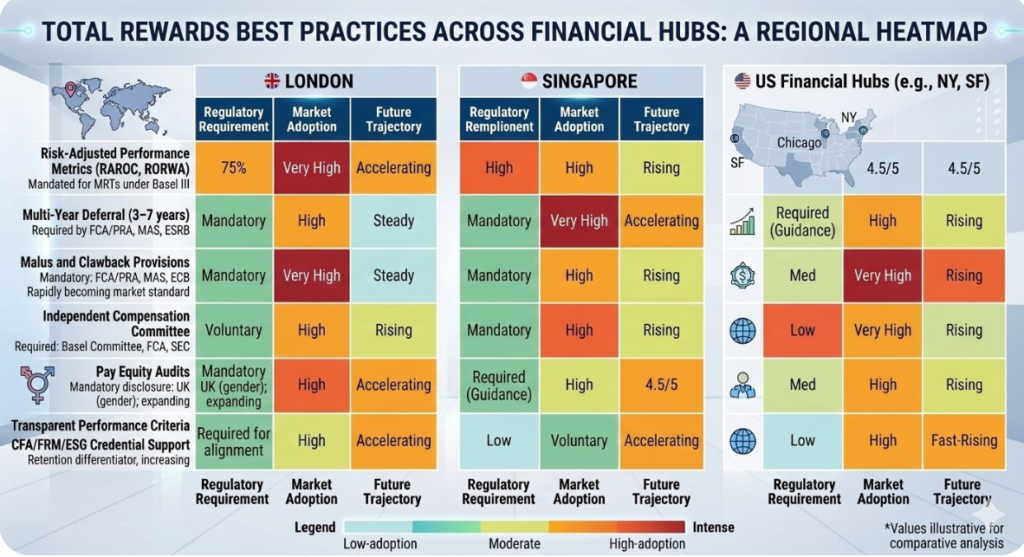
A heatmap showing the adoption of each best practice across London, Singapore, and US financial hubs, rated by regulatory requirement, market adoption, and future trajectory.
| Best Practice | Global Adoption & Standard |
| Risk-Adjusted Performance Metrics (RAROC, RORWA) | Mandated for MRTs under Basel III; standard practice across G-SIFI institutions |
| Multi-Year Deferral (3–7 years) | Required by FCA/PRA (UK), MAS (SG), ESRB (EU); strongly encouraged by Fed (US) |
| Malus and Clawback Provisions | Mandatory: FCA/PRA, MAS, ECB; required: US Federal Reserve guidance SR 11-7 |
| ESG-Linked Incentive Metrics | Voluntary but rapidly becoming market standard across FTSE 100, S&P 500 financial institutions |
| Independent Compensation Committee | Required: Basel Committee, FCA, SEC proxy rules, MAS; best practice globally |
| Pay Equity Audits | Mandatory disclosure: UK (gender); expanding to ethnicity pay gap; SEC exploring US mandate |
| Transparent Performance Criteria | Required for alignment with SMCR (UK), MAS MASNotice 637; best practice globally |
| CFA/FRM/ESG Credential Support | Market standard in tier-one institutions; increasingly a retention differentiator |
Financial Inclusion and Social Responsibility in Human Capital Strategy
Global banking institutions face a growing expectation — from regulators, investors, and society — to extend their human capital commitments beyond their own workforce to the communities they serve. The World Bank’s financial inclusion agenda and the UN’s Sustainable Development Goals (particularly SDG 8: Decent Work and Economic Growth) frame this expectation in a global development context.
Forward-thinking institutions are embedding financial inclusion into their human capital strategies through:
• Community investment programmes: Structured volunteering and skills-sharing with underserved communities, including financial literacy education.
• Diverse talent pipelines: Partnerships with universities and schools in lower socioeconomic communities to broaden the talent pool accessing financial services careers.
• Living wage commitments: Accreditation by the Living Wage Foundation (UK) or equivalent bodies in other jurisdictions signals genuine commitment to fair pay beyond the regulatory minimum.
Conclusion: The Future of Human Capital in Global Banking
The transformation of human capital strategy in global banking is not a trend — it is a structural shift that will define which institutions lead and which follow over the next decade. The most successful financial institutions in London, Singapore, New York, and beyond will be those that treat their people not as a cost to be managed but as an asset class to be invested in.
The convergence of regulatory pressure (Basel III, FCA SMCR, MAS guidelines, Dodd-Frank), market competition for top-tier talent, and stakeholder expectations around ESG and purpose has created both the imperative and the framework for a new era of human capital investment.
The key strategic conclusions for financial institutions navigating this landscape are:
• Variable pay must be genuinely risk-adjusted — not merely performance-adjusted. The distinction matters both regulatorily and culturally.
• Total rewards must be truly total — encompassing wellness, development, equity, and purpose, not just cash compensation.
• ESG integration in compensation is no longer optional — it is becoming a regulatory expectation and a market differentiator.
• Digital transformation demands digital talent strategies — including compensation structures borrowed from the technology sector.
• Transparency and governance integrity are the foundation of any high-performance compensation architecture — opaque or poorly governed pay systems destroy the very engagement they are designed to create.
Looking Ahead: As AI reshapes the nature of work in financial services, human capital strategies will need to evolve further — incorporating competency-based pay models that reward adaptability and learning agility, not merely current technical skills. Digital currencies and tokenised asset markets may also introduce new equity-like instruments for talent reward. Institutions that invest now in the governance infrastructure, cultural foundations, and data capabilities required for sophisticated human capital management will be best positioned to lead in an increasingly competitive global talent market.
Frequently Asked Questions (FAQ)
1. How does the Basel Committee’s guidance on compensation apply to all banks globally?
The Basel Committee on Banking Supervision (BCBS) issues principles and standards that are then implemented by national regulators. While the BCBS does not directly regulate individual banks, its Sound Compensation Practices are incorporated into binding regulations by member jurisdictions — including the FCA/PRA in the UK, MAS in Singapore, the Federal Reserve in the US, and the EBA in the EU. For banks operating across multiple jurisdictions (as most global financial institutions do), compliance with the most stringent applicable standard effectively sets the floor for compensation governance globally.
2. What is the difference between malus and clawback in performance-linked compensation?
Malus refers to the reduction or cancellation of deferred compensation that has been awarded but not yet paid out — a withholding mechanism activated when an employee’s performance or conduct is subsequently found to be deficient. Clawback goes further, requiring the recovery of compensation that has already been paid. Clawback provisions are typically activated in cases of material misconduct, financial misstatement, or systemic risk failures. Both mechanisms are required under UK FCA/PRA rules, MAS Notice 637, and are strongly encouraged by the Federal Reserve’s SR 11-7 guidance.
3. How can mid-sized financial institutions compete on total rewards against bulge bracket banks?
Mid-sized institutions can compete effectively by focusing on the dimensions of total rewards where they can genuinely differentiate: purpose and culture (a stronger sense of personal impact), professional development quality (more personalised than large institutions), flexibility (hybrid and remote working models), equity participation depth (extending meaningful equity to a broader proportion of staff), and targeted wellness programmes. Research consistently shows that for high performers, the quality of management, the calibre of colleagues, and the sense of meaningful work often outweigh headline compensation above a certain salary threshold — areas where smaller, more focused institutions frequently excel.
References, Further Reading & Suggested Links
Readers seeking deeper engagement with the topics covered in this article are directed to the following authoritative sources:
• Basel Committee on Banking Supervision — Principles for Sound Compensation Practices: https://www.bis.org/bcbs/compprinciples.htm
• IMF Financial Sector Assessment Program (FSAP): https://www.imf.org/en/About/Factsheets/Financial-Sector-Assessment-Program
• FCA Remuneration Guidance (SMCR/MRT): https://www.fca.org.uk/firms/remuneration
• MAS Notice 637 — Remuneration Framework: https://www.mas.gov.sg/regulation/notices/notice-637
• Federal Reserve Guidance SR 11-7: https://www.federalreserve.gov/supervisionreg/srletters/sr1107.htm
• World Bank Human Capital Index: https://www.worldbank.org/en/publication/human-capital
• CFA Institute — ESG Certificate: https://www.cfainstitute.org/en/programs/esg-investing
• GFANZ Net Zero Commitments: https://www.gfanzero.com
© 2026 | Global Banking & Finance Insights | Published for educational and professional development purposes. Always consult qualified legal, regulatory, and financial advisors for institution-specific guidance.